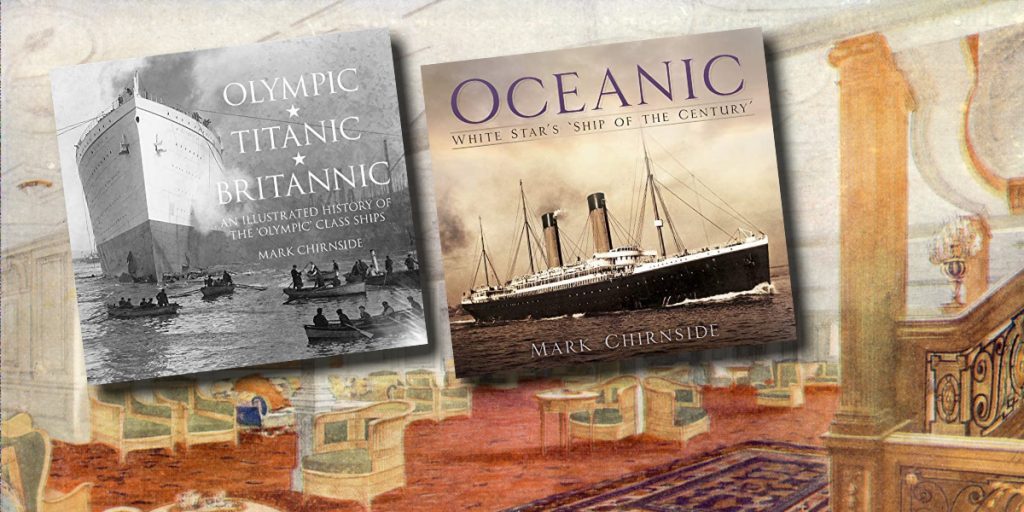
THE ‘OLYMPIC’ CLASS SHIPS: OLYMPIC, TITANIC & BRITANNIC

‘Terrific book…amazing work…can’t put it down… prodigious…fantastic…extraordinarily researched…highly recommended…priceless…a jaw dropper.’

PUBLICATION DETAILS

Chirnside, Mark. The Olympic Class Ships: Olympic, Titanic & Britannic. Tempus Publishing; October 27th 2004. 352 pages.
Reprinted: January 2005.
Reprinted: December 2006.
Reprint and corrections page: The Olympic Class Ships: Olympic, Titanic & Britannic
Purchasing Information: ready to purchase? Click here.

PUBLISHER’S TEXT AND PRODUCT DESCRIPTION

Sitting around a dining–room table in 1907, the owners of the White Star Line discussed their competition to the newly–built Cunard liners, Lusitania and Mauretania. From that smoke–filled room came the first designs of three White Star superliners. Olympic and Titanic were to be built at Harland & Wolff’s yard in Belfast, while the third ship, Britannic, was to follow after construction had been completed on the first pair of sisters.

Each ship was subtly different. Lessons learned from the service of Olympic were put into practice for Titanic. With the loss, on her maiden voyage, of Titanic, the hull design was radically changed for the third sister ship. The new double hull, however, did not prevent Britannic from sinking in less than an hour in the Aegean after she hit a German mine in 1916.

Illustrated with many rare images of all three vessels, only one of which survived in regular service, this is the definitive history of the most famous sister ships of all time.

REVIEWS

‘The number of titles that have attempted to tell the story of all three liners in one volume is astonishingly short. In this new book, Chirnside has done the triplets proud, with a thoroughly researched history of each of these vessels. Like many new authors, he is still finding his voice. Some of his language is a bit stilted at times, and there are some places where his precise meaning isn’t clear. But these glitches are minor, and shouldn’t distract you from enjoying this book...

‘You can’t tell everything there is to tell if you are trying to cover the history of three ships in one book. But the major events of her service are represented. What we don’t get in quantity, is more than made up for in quality, as the depth of detail goes beyond most other titles. Every book about Olympic goes over the story of the Hawke collision, for example, but few cover the material as thoroughly as Chirnside does… There is a solid amount of material on many of the competing lines’ ships as well, all weaving a rich tapestry of maritime history in peace and in war spanning several decades…

‘There are eleven pages of footnotes, and a two page bibliography. My only real gripe is the embarrassingly short, one page index. Completely insufficient for the volume of information to be found in this book…

Has the ultimate history of the Olympic class trio been achieved in this book? Maybe. Maybe not. But Chirnside has come closer to hitting the bull’s eye than any writer before him.’ – Michael Tennaro.


‘Exhaustively researched, this book is not just a rehash but contains much new and original material.’ – Titanic Historical Society museum shop website, December 2004.


‘Your book is by far one of the best that has appeared amongst the plethora generated by the discovery of the wreck and Cameron’s film in the past few years…There is no other book I’ve come across that has so comprehensive and detailed a history of the Olympics – it’s unique to find a book that has such a wealth of detailed technical description together with a list of the dignitaries at the launching under the same covers – the research is impressive. Moreover, your synopsis of the history of White Star and brief discussion of the Cunard rivals puts the ships perspective from both a historical and business point of view. My own opinion is that you have succeeded very well in the purpose you stated in the preface – comprehensiveness and context for the expert, the enthusiast and the general reader.’ – Alexander Weintraub, December 4th 2004 and December 5th 2004.


‘Your “Olympic” class book is fantastic! I pick it up all the time and read and re-read segments out of it...I took the book with me on my Thanksgiving trip, and my friend kept saying, “I can’t tear you away from that book!” It’s regrettable that today’s ships have none of the grace and architectural interest that the Olympic embodied in her design to an art-form. Your book is certainly the most concise history ever written on the Olympic and her sisters.’ – Pete Hodges, December 5th 2004.


‘Wow, you’ve really outdone yourself. So many rare photos and information in your book. I had to brag to my fellow co-workers that I knew you. What a terrific book.’ – Carl Ireton, December 6th 2004.


I am amazed at the amount of info you have on the Olympic. Amazing work!…You have really provided some background on that area that is new and fresh.’ – Michael Condon, December 19th 2004.


‘Chirnside’s story of the three Harland & Wolff “Olympic” class ships acknowledges the public’s fascination with the Titanic, but also directs attention to the equally compelling sagas of the Olympic and the Britannic. The comprehensive study of the ships includes reports from their passengers, descriptions of their lavish appointments, and the details of the catastrophes that each experienced. The volume is illustrated with rare images of the vessels and supplemented with trial testimony, and comparisons of these ships with their contemporaries.’ – ‘Book News’ annotation, 2004. Powells Books


‘If you are interested in even the chemical composition of the glue used to lay the tiles in the grand entrances to White Star’s Big Three, then this is definitely a book for you. Author Mark Chirnside can be given full marks for his research but his editors might have been a bit more helpful in editing…run-on sentences, syntax and grammatical errors…For those who love everything to do with Titanic, Olympic and Britannic this does make for an excellent resource book. Some excellent and rare photos not generally found in the dozens of books on the subject also help. However, economy seems to have compelled the editors to use a poor reproduction technique for these otherwise interesting pictures…As a mass-market book, many will run into trouble with the technical wording which, when combined with Mr. Chirnside’s questionable writing skills can make this a hard read. Footnotes, bibliography and [the] detailed appendix [sic: appendices?] confirms Chirnside has definitely done his homework. While scholarly, I blame the editors more than Mark Chirnside for the painfully convoluted sentence structure…This book did have the potential to be a fascinating read, but alas a good scholar is not always a good writer. If you are a devout fan of the engineering aspects of the “Olympic” class vessels, then it should be in your collection…’ – Timothy R. Laurence, Commercial Film Director & Writer. January 24th 2005. Barnes & Noble.com


‘Book of the Month: This book claims to be the definitive history of the most famous sister ships of all time and at 350 pages in length it is extremely thorough in its treatment of the subject…The details about the ships are truly comprehensive and all aspects of the ships are covered. However, while this is ideal for those concerned with liner minutiae, it is perhaps too much for a more general audience. Many original and previously unpublished photographs have been included which, while well reproduced, would have benefited from being somewhat larger, particularly the line drawings.’ – Ships Monthly, February 2005.


‘…wanted to tell you how much I enjoyed reading it. [It] had a lot of very interesting new stuff in it – and after reading for 50+ years on the “Olympic” class liners – it’s very interesting to read something new. I’ve resisted buying new books about the “Olympic” class ships basically because they’re “same old – same old” stuff – but, your book was a refreshing break from this mould. It’s joined the extensive collection of books in an honoured position!’ – Ray Lepien, February 1st 2005.


Fascinating details about the three sister ships, probably the most magnificent ever built, only one of which survived more than a year. My favourite story: When the Titanic went down and the Olympic’s captain offered to come to help the rescue, the Carpathia’s captain advised “that it was not advisable for the survivors to see Titanic’s nearly-identical-looking sister.” Indeed! Then there’s the story of Violet Jessop, who sailed on all three ships, including two of them when they sank.

The book is fluidly written, and lavishly illustrated with photographs rarely seen in other books. My only quibble with the book is one factual superficiality: Chirnside says “Titanic had finally been located 13.5 miles to the south-east of Fourth Officer Boxhall’s position, while it is hotly debated how he could have been so wrong.” Excuse me, but Boxhall gave out a position that was so accurate that when the Carpathia finally arrived for the rescue, the Carpathia captain congratulated Boxhall for being so accurate. How the Titanic managed to drift 13.5 miles away to where Dr. Ballard found it, is a great mystery to this day (underwater currents and a massive under-seabed tsunami earthquake that occurred around 1920, appear to be the best answer).

This book is so rich in detail, and so well-written, that you get “hooked” and can’t put it down... A prodigious effort, masterfully executed.’ – Agorathecat, Bucharest, Romania. March 25th 2005. Amazon UK

Author’s Note: I must respectfully disagree as to the drift theory. While Boxhall must be congratulated for his work on the ship’s position, which aided the search and rescue efforts, and prompted Carpathia’s Captain Rostron to offer his congratulations as to its accuracy, there are two elements to any position. The consensus does seem to be that the Titanic was ‘on course,’ which aided the Carpathia’s rescue mission, yet it is undeniable that Boxhall’s calculated position put her over thirteen miles further ahead than she actually was – a position worked out under the most trying circumstances. With regard to the ‘drift theory,’ for Titanic’s wreckage to have drifted 13½ miles during the 2½ mile descent to the seafloor, she would have needed to have travelled almost 5½ miles along (at a very shallow angle) for every mile that she descended – an implausible scenario. Indeed, it would have taken Titanic just over half-an-hour to cover 13½ miles on the surface if she was being driven at high speed. It seems unlikely that the 1929 ‘Grand Banks’ earthquake could have lifted the sunken ship’s major sections, and deposited them over thirteen miles away without leaving some trace.

‘I have been reading books about the great liners and the White Star & the Cunarders in particular for more than fifteen years…I received the book yesterday. It’s fantastic. I hope to be able to buy the other book [RMS Olympic – Titanic’s Sister] quite soon. Congratulations, I expected a great book, but it’s even better than that… extraordinarily researched and documented book.’ – Miguel Valpuesta, Spain, April 8th 2005.


‘About six years ago [1998], three authors produced Titanic and Her Sisters, Olympic and Britannic. A massive, coffee-table-sized book packed with photographs; the volume was widely distributed, but badly flawed by factual errors in both [the] text and photo captions.

‘Now a 20-year old British university student, Mark Chirnside, has published a new volume with a similar subject matter, but a different approach. Gone are the large scale, heavy weight book and its hundreds of photographs. In its place, a text-dense volume with fewer photographs but far more accuracy.

‘Several impressions great the reader. The first is the extensive quotation from a wide range of sources, which lends credibility to the text.

‘The second is the impressive amount of detail. Discussion of the Olympic-Hawke collision and the “mutiny” of the Olympic’s crew over faulty lifeboats is full and appropriate. The description of Olympic’s interior arrangements as a troop transport is noteworthy. Titanic and Britannic are ably developed, and new details are offered, including onr [sic] that lights in the third class public bathrooms were controlled by opening the door.

‘Given the subject’s complexity – providing a general history of three vessels whose stories intertwine with one another – Chirnside’s organisation is excellent.

‘Here and there, a bit more editorial blue pencil might have been applied where awkwardness or imprecision is apparent…The book’s one-page index is scanty and insufficient…

‘…The Olympic Class Ships serves as a fine summary of three important ships’ life stories, but also as an [sic] significant introduction to an able, thoughtful new maritime writer whose work shows considerable promise. The book is highly recommended.’ – Charles A. Haas. ‘Book Looks.’ Voyage 2004; Issue 50: Page 94.

Author’s Note: The review incorrectly states that, according to the book, ‘lights in the third class public bathrooms were controlled by opening the door.’ In fact the book states that this feature was to be found in the first class public bathroom design. While a more detailed index would certainly have been desirable, in light of the number of pages available in the book template my publisher advised me that was necessary to keep the index to less than two pages in length. (The book’s projected length had already increased from 320 to just over 350 pages prior to publication.) It would not have been possible to include items such as locations and people as well as ships and shipping companies, as due to the number of people mentioned in the book (from various company directors, to ship’s captains, officers, judges, and, more recently the many people who have explored the sunken Titanic and Britannic) that would have pushed the index well beyond two pages in length.

‘I find it very good reading, especially all the info. relating to Olympic’s wartime service, the collision with HMS Hawke, etc., and eye witness accounts of Britannic’s demise.’ – David Short, May 1st 2005.


‘When I got my copy of Mark’s book, I thought “oh no, another Titanic book, I have probably read it all before.” But I was pleasantly surprised. Titanic as we all know was one of three great ships, Olympic and Britannic being the others. For those of you who haven’t read many books on the subject then this is a must. Mark has done all three ships proud…His research is very good as regards the history of these vessels. The start of the book is basically about the construction of the “Olympic” class ships. The Accounts of all three ships follow albeit individually, and the section on Olympic herself, as she had the longest service with White Star[,] is well covered. The opening chapters is [sic] on the history of the White Star Line, there is a chapter all about the specifications, specially for rivet counters amongst you. The book also covers such things as Olympic’s collision with the cruiser Hawke and also included is an account of Carpathia’s rescue bid when Titanic foundered. The sinking of Titanic is also covered, as well as a section devoted to Britannic. I found it a good book and it takes pride of place amongst my collection of Titanic related books – although I found myself going back over certain bits as I thought I had read it wrong. But all in all it has covered all three of these ships admirably and to a young up and coming author, I only have one thing to say “Well Done.”’ – John Dray, July 3rd 2005. John Dray's Book Reviews.


‘I finally acquired a copy of your “Olympic” class ships book. It is superb! I cannot get over how well written this book is. There is so much information within, your book requires repeated readings...The only thing I would have wanted was more photos – but the information within was priceless, and the photos used superb. The previously unpublished stern shot of Titanic leaving the dock was a jaw dropper...’ – Tarn Stephanos, August 13th 2005.


‘I own both the book about the Olympic and also The Olympic Class Ships. I think they were both excellent, and I hope you continue to write more in the future.’ – Mike J. Miller, September 20th 2005.


‘Mark Chirnside has managed to write one of the most well-researched books ever written about the three liners. Considered by many the best Titanic-related book of 2004. The Britannic section is more than complete and even includes information regarding all the diving expeditions to the wreck. In the eleven appendices you will find a list of features showing the main differences between the three vessels, a detailed chronology of the “Olympic” class, details regarding Britannic’s wreck, comparisons between Britannic and Aquitania, a complete list of Britannic’s victims and many additional information regarding the Olympic, the Titanic and the White Star tenders (Nomadic and Traffic). Vote: 10/10.’ – Michail Michailakis. October 1st 2005. Hospital Ship Britannic: Research


‘…an excellent addition to any maritime library is Mark Chirnside’s book on the “Olympic” Class liners. It sets out to examine the background to Olympic, Titanic and Britannic, as a class. It is a very readable book, full of information presented in an entertaining way and which I have no hesitation in recommending to our [Irish Titanic Historical Society] members. ’ Ed Coghlan. White Star Journal 2005; Volume 13 Number 3: page 7.


‘I would just like to say again how much I have enjoyed reading your books! I’ve have read both The “Olympic” Class Ships and RMS Olympic numerous times – and find them just as fascinating as the first time I read them!’ – Evan Meyerriecks, December 27th 2005. Webmaster: Ship Magnificent - The RMS Olympic


‘I highly recommend Mark Chirnside’s The “Olympic” Class Ships. It’s very informative and well-researched, especially when you consider the author – who is far too modest – only just turned 20!

‘Using many reliable, hard-to-get primary sources Mark has written a concise yet comprehensive reference book on the lives of Olympic, Titanic, and Britannic. While full of technical details, this book is never dry or boring; it belongs on the shelf of anyone doing serious research about Titanic or her sisters.’ – Cathy Akers-Jordan, Lecturer of English, University of Michigan, Flint Campus. USA. February 28th 2005 and January 3rd 2006.


‘I just finished The “Olympic” Class Ships and have really enjoyed it. Fantastic!’ – Thomas Foster, February 7th 2006.


‘An amazingly detailed book…Clear, descriptive text, lots of relevant information that I have never come across before. I think these two books are aimed more at the praise and magnificence of these liners, a little criticism where necessary, which is good. As there are books and documentaries out there that merely “criticise” these liners in almost every aspect. I am drawn by the attention grabbing front cover – setting a brilliant image.’ – Mitchell Fletcher, Nottinghamshire, April 3rd 2006.


‘It is not altogether surprising that Titanic has overshadowed her sister ships, given the dreadful circumstances of her loss and the liner’s ability to continue making news 95 years later. Mark Chirnside sets out to remedy this by bringing together, in one volume, the background to the famous sisters…

‘The opening chapters set the scene by providing an excellent potted history of the Oceanic Steam Navigation Company, White Star’s official name, a brief note on Harland & Wolff, the Belfast shipyard where all three were built, and the competition provided by Cunard’s Lusitania and Mauretania. The inclusion of Aquitania reminds us that Cunard also planned three quality liners for its New York run…The chapter on the background to the creation of the new class provides a wealth of technical information…Indeed, throughout the book there is an abundance of technical data on the three sisters, but it is nicely balanced by a wealth of interesting detail that will entertain anyone with an interest in maritime history…

‘Overall, Mark Chirnside has produced a very readable book, crammed with all sorts of information from technical data to the anecdotal. For a work of its size, it is curious that there is only one index page. Some typing errors not caught at the proof reading stage would normally be an irritant, but it says much for the book that the quality of the data provided more than compensates for this.

‘The reader is provided with a fascinating insight into the maritime world of the early 1900s, and in a very easy writing style White Star’s three sisters are brought to life. I strongly recommend the book and eagerly await future publications from the same source.’ – Ed Coghlan. White Star Journal 2006; Volume 14 Number 1: pages 16-20.


Very informative. This book is my favourite of all time. I thought I knew everything there was to know about the Titanic and her sisters, but I was wrong. This book is amazingly plentiful with information. Makes for a great read.’ – David A. Gautreau. January 9th 2007. Amazon.com


I was very impressed with the depth of research and writing that Mark Chirnside has done on the subject of the White Star Line ships. This book is a great addition to any library. There were many new facts and anecdotes about the Olympic, Britannic and Titanic that I did not know. Perhaps the only quibble is that as solid as the text is regarding the Titanic sinking – the same old accounts were used. Necessary in some instances, but some other accounts that are used far less could have enhanced the chapter. The other thing is that the book deserves a better format. I would think that such a book deserves a larger format, giving the reader an easier time to examine the pictures and reading the text. Overall – the book succeeds in making the reader learn more about these ships.’ – Michael Poirier. January 25th 2007. Amazon.com


‘To tell the story of the “Olympic” class ships in a new and compelling way has always been a challenge. Millions of words have been written about the Titanic, while at the same time giving scant mention to her sister ships. With nearly every conceivable angle covered, Mark Chirnside’s fresh approach is both welcome and appreciated. With a depth of knowledge on the subject that is matched by a very few, Chirnside has taken an in-depth look at each of the three ships, writing a separate chronological history and relating important parts of each ship’s story where applicable to others in the trio…

‘The story of Olympic is told with great attention to detail, carefully leading the reader through the conception, design and service of the first of its kind ship. Written with a storyteller’s flair, each phase of the Olympic’s career is covered, omitting no salient detail. She is portrayed in a way that makes it easy to see why she was known as “Old Reliable.” As the longest lived of the trio, she also became one of the most popular ships of the 1920s and Chirnside points out how the White Star Line’s awareness of their competition continually updated their ship to keep her attraction strong.

‘The brief lives of Titanic and Britannic are also covered with a wealth of information on not only how each ship differed in design and construction, but also why changes to the ships were made. Both vessels are followed from design and completion to their service careers. This is not a cookie cutter approach, rather one that treats each ship separately and with strong concentration on individual features.

‘Again, it is difficult to describe what happened on Titanic’s last night or the Britannic’s last sunrise in a fresh and different way, however Chirnside has proven himself equal to the task. The story of each ship’s demise is presented carefully and accurately; each sinking is given a thorough forensic analysis. At no time does the narrative become repetitive or boring – even to this reviewer, a long time student of the “Olympic” class ships.

‘In particular, the Britannic’s sinking has been quite misunderstood and Chirnside debunks the possibility of a coal bunker explosion being responsible for a quick descent. Instead the focus of attention is on open scuttles being the cause for massive and unnecessary flooding.

‘The discovery of each sunken liner is presented, with an examination of every expedition to each ship, giving the who, what, where, when and why of each visit to Titanic and Britannic.

‘My hope is that Mark Chirnside will take his great skill and depth of knowledge and use this book as the basis for a magnus opus on the three “Olympic” class ships – writing a multi-volume set similar to what Frank Braynard did with the Leviathan.

‘Profusely illustrated with over 100 photographs, the book is heavily footnoted, indexed and has eleven appendices detailing different aspects from a straight comparison of the three, to a section on the Nomadic and Traffic to yet another section investigating – and putting to rest – claims that the Titanic was short of coal.

The ‘Olympic’ Class Ships will prove to be a vital addition to ones bookshelf and is destined to be a classic. It should be given a place next to Walter Lord’s A Night to Remember and Don Lynch and Ken Marschall’s Titanic: An Illustrated History.’ – Tim Trower. Titanic Commutator 2006: Volume 30 Number 126: pages 206-07.


AUTHOR’S NOTE

When completing the listing for those who had lost their lives in the sinking of the Britannic, the records held by the Commonwealth War Graves Commission (CWGC) were of considerable assistance. In fact, much of the data for each person comes from their records alone. While accepting the casualty lists as presented back in 1916, the CWGC records did have some errors in them – for instance, Cropper’s grave was not mentioned in some of their records. As a result, there was information on some twenty-seven people – with several missing. Fortunately when I shared my listing with Michail Michailakis back near the beginning of 2002, he was able to point out the missing people – it turns out that some of them were not mentioned in some records, since the CWGC had their own information as to the names on memorials, but the crew listing could be used to fill in the missing gaps.

The issue of Britannic’s ‘two’ Second Officers requires attention – ‘Brockehurst’ and ‘Brocklebank.’ While the two names are remarkably similar, it had always been assumed that they were two different people. However, when further Officer research revealed no trace whatsoever of an Officer with one of those names, that brought into question the possibility that they were the same person. Indeed, with the names ‘Alfred’ and the initial ‘A’ the possibility became even stronger. With no trace being found for one of the names it seems increasingly likely that one is a mistake and that they are indeed the same person, with the records that do exist for the other name being those of Britannic’s Second Officer. This debate has been addressed in my recent (2005) research article.

One error that was corrected before publication concerned Britannic’s First and Sixth Officers on her final voyage. While I had correctly identified the Officers after her lay-up in summer 1916, in fact the First and Sixth Officers changed that autumn 1916. The fact apparently went unnoticed for years until Simon Mills was going through the manifests again and corrected the names for her final voyage…that became widely known in 2002, and as a result of his assistance it was possible for me to briefly alter these two names in my book – at about the last stage that any minor corrections were possible. Apparently everyone who has ever looked at these manifests had missed the changes after initially going through the listings. Through my own research, I have now determined the precise dates for every appointment concerning the Britannic’s Officers.

To my knowledge nothing about the ‘Peskett report’ (Cunard’s Naval Architect reporting about Olympic’s voyages in August 1911) had ever previously been published in book form.[*] Yet the report was fascinating in terms of life onboard Olympic at this early stage of her life. While I felt that his analysis was rather biased in some respects – reflecting the Cunard and White Star Line rivalry – and in some cases justifying his professional opinion (for instance with regard to the superiority of an all-turbine installation), it was also fascinating. His information about Olympic’s performance also contributes valuable data about her propulsion system, and sheds some light on Titanic’s maiden voyage performance the following year. His comments about changes to the Turkish baths, and swimming pool, might be considered to point to possible changes made to Titanic – and which we might not otherwise have heard about. That he took a sample of the Emdeca from the cooling room, was a blessing – I was able to note the colours and touch it, the 1911-sample now becoming flaky. And the ‘superior class’ of first class passengers who he noticed – those paying extra for the á la Carte restaurant – was revealing. I had certainly not heard of anything like that happening, and I don’t think I had ever seen anyone else mention it – or seen it in any of the liner books I’d read. Indeed, when I confidentially shared the report with several knowledgeable people, it seemed my feelings about it were correct…that it contained a mass of new information relevant to Olympic, and – to an extent – Titanic. No one who I shared it with had ever seen it published. Several established researchers had never heard of it. Why not? Perhaps because few Olympic-Titanic researchers will see any point in going through eighty dusty files/boxes of material relating to the Aquitania’s design and construction in 1910-14 – and of which Peskett’s report makes up just one. And few Aquitania researchers would have found it of great interest, in the light of the fascinating boxes of documents relating discussions about her décor, design and specification. Yet it’s quite logical Cunard would have examined the ‘Olympic’ class’ design closely, since their new Aquitania would have been at the forefront of their efforts to respond to White Star’s challenge…along with minor upgrades to Lusitania, for instance, like the debate about upgrading her veranda café.

In my view, the Peskett report is one of many potential new sources of information that have remained overlooked (even after the mid-1990s when interest in all things Titanic-related soared), until recently. No doubt there are many more items out there, but I am proud that in this book a lot of information is published for the first time ever. One small example is the knowledge that Cunard-White Star were involved in discussions in 1935 to dispose of the Olympic to a consortium for use as a floating hotel. This provides a counter-argument to the view that the idea of a floating hotel (like the Queen Mary from the 1960s) would not have entered anyone’s minds in the 1930s. I think the numerous reviews that I have seen demonstrate that a number of people found the book interesting and even people who had been interested in the subject for years found some new material. This provides a well-informed counterpoint to those who worried, before the book had even been published, that it would simply be a ‘re-hash’ of what had gone before. Judged in its totality, I trust that I can say that is not the case at all.

Readers with any documented corrections are invited to contact Mark in the hope that mistakes can be rectified in any future editions.

PURCHASE

THS - The Olympic-Class Ship Olympic, Titanic, Britannic

Signed copies are available by contacting Mark, using the e-mail address in the ‘contact me’ feature on the Home page.

Home


[*] I have since found out that in Matthew Tanner’s article, ‘Satisfying The Paying Public: The Effective Interpretation of Historic Ships and Boats,’ for the San Francisco Maritime Park Association, dated July 7th 1997, the Peskett report is briefly referenced from the Merseyside Maritime Museum archives – raising the possibility that multiple copies exist. However, it would apparently still be correct to say that it had never been published in a book before.


Home / Books Index / Interviews Index / Articles Index / News Index / Updates / Sitemap

Mark Chirnside's Reception Room ©2004-